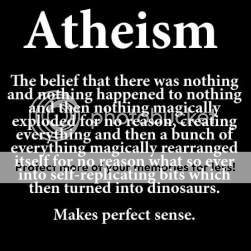
 I honestly don't even have to refute the stupidity this image bears, but I will. First off, atheism is the lack of a belief in deities. Nothing more, and nothing less. The Big Bang was an explosion (or expansion if you will) of energy and matter, and in this process the protons, electrons and neutrons traveled in the rift of the expansion of time and space themselves. Our universe, which could very well be predated by others, and to the best of our knowledge, began this way.
After about three-hundred eighty-five thousand years or so, everything had cooled sufficiently enough for the particles to form atoms. A lot was basic hydrogen, and the rest was helium. As these original atoms were being formed, think of hydrogen, helium, protons and the like being carried through a dark and void cosmos.
Scientists speculated that there must have been denser parts of the early universe, otherwise they couldn't have came together later to create stars. The heat imprints of these early clouds, which grew hotter as they were more compacted, were observed and confirmed by NASA's Wilkinson Microwave Anistrophy Probe, which spent years collecting data from lightyears away.
Over millions upon millions of years, gravitational pull brought the aforementioned denser clouds together, and of course the more dense they became, the stronger the gravitational attraction. Each swirling cloud spun, until they became tight balls of gas. The insides of each ball of gas became pressurized, and whenever a gas is compressed, it gets heated.
The hydrogen atoms began vibrating faster until they were clashing into one another with enough speed to have a fusion reaction—and thus, helium was formed. And since each nuclear fusion reaction is accompanied by the release of energy, the energy made other hydrogen atoms reverberate even faster, fusing more of them, which releases more energy, which fuses more atoms, and like trillions of bombs going off in a chain reaction in that instantaneous second, the clouds ignited, forming the first stars and lighting up our cosmos.
After that, gravitation brought in early clusters of stars to form galaxies and, powered by fusion, the original stars burned for billions of years. Of course, a star only has so much fuel, and as it is used up, the it begins to collapse, pulling the gas orb tighter. Pressurization and temperature increase until they're intense enough for helium atoms to come together. This creates stronger and heavier atoms, like carbon and oxygen.
With more heat and pressure, even these stars fuse, until the star begins to forge every single element thereafter. This happens until the pressure and temperature are so great that the star explodes, spreading itself through space. The shockwaves throw the contents against clouds of hydrogen and helium that were motionless in space for even millions of years, which means that, in a way, the cycle of a star's existence is a bit like reincarnation. Or, well, it begins anew.
By that time, the gas cloud is riddled with heavier elements. Accretion is when dust and other debris are pulled together under gravitational attraction to create rocks, bolders, and the like, and then larger structures. Through hundreds of millions of years, accretion created our humble Earth, which was the proportionate amount away from the then-formed Sun so that water remained a liquid. At first the Earth was extremely hot because of millions of years of collision.
As the molten ball cooled, a crust was formed over it. A few more million years after forming, the Earth was cooled enough for water to condense, and over the next billion years chemical reactions created replicating cells.
Abiogenesis explained in one paragraph: During the very primordial earth, things like methane, water, ammonia and hydrogen were floating around in the atmosphere. With electrical activity (such as lightning from the sky), these compounds can catalyze into amino acids, the building blocks of life, and create proteins in living cells. This formed ribonucleic acid (RNA), which well predated DNA.
Now would seem a fitting time to tackle evolution and wrap this up. For starters, sedimentary rocks are something like the pages of a book. The lowest of its layers contained a small variety of primitive aquatic species, just as the higher sedimentary layers held a variety more of complex creatures. Some argue that this progression indicates that the species didn't appear quickly, but were gradually evolving. However, there are some missing links, what with all of the global mass extinctions, but that is to be expected when dealing with catastrophes.
Each of these, however, were followed by the recolonization of the Earth via surviving organisms, and thus morphed, becoming more and more complex until the next mass extinction occurred in succession. As we track the fossils of these species, we see an bountiful increase in complexity as they've changed by means of sedimentary rock. It is quite clear that we're witnessing a changing morphology of a single species through time, or each species is getting killed off and replaced by other species which are almost identical. We also see traces of an animal's evolutionary ancestry in its morphology.
A common misconception about the theory of evolution is that human beings evolved from modern apes, which simply isn't true. I subscribe to the belief of Natural Selection, which I will explain now. Under this hypothetical: Imagine you have mammals of all characteristics, but of the same species. Some of them have longer necks, some of them harrier bodies, some of them shorter than others, and so on. Imagine the climate changes cold, and the ones with the harrier bodies would have the most likelihood of surviving; others die off.
This is microevolution, which suggests that a single species can change its characteristics, but doesn't change into a new species over time, through reproduction. Now, continuing this hypothetical, imagine the climate and conditions changed again, and this time would require the mammals with the longer necks to eat the best, like from taller trees, and thus survive. Reproduction would change the characteristics of all of the surviving mammals, with only the ones mutated for the environment remaining. This is survival of the fittest.
These changes would continue, and the mammals would keep reproducing, changing, surviving, and repeating this process. As they gradually change species, it becomes harder and harder to reproduce through changing chromosomes. Take, for example, that the modern horse separated from zebra millions of years ago. Horses and zebras can reproduce today, albeit with difficulty, since a horse has sixty-four chromosomes and a zebra a mere forty-four.
Each species can reproduce with the one in a direct ascendancy with it until they reach the end of the evolution, and macroevolution, which is the entire changing of species, happens. This is when interbreeding is simply impossible. This is observed in animals, and a connection between hominids and homosapiens.

No comments:
Post a Comment